
Copper: The Reindustrialization Metal
America has decided to build again. Data centers, power generation and transmission, the defense industrial base, factories brought back onshore, electric vehicles and the network that charges them.
Copper is the one material every part of it depends on.
The United States imported 57% of the refined copper it consumed in 2025, and it will need more: more ore mined, more scrap recovered, and far more capacity to turn either one into metal.
Wherever there is electricity, there is copper.
Data centers. A data center is a building full of conductors. Testifying to Congress in April 2026, the Copper Development Association put it plainly: “Data centers are among the most copper-intensive facilities ever constructed… Every gigawatt of new AI computing capacity requires thousands of tons of copper.” Lawrence Berkeley National Laboratory put data-center electricity use at 176 TWh in 2023, about 4.4% of the national total, and projected 325 to 580 TWh by 2028.
Power. Electricity has to be generated, stored, stepped up and down, and carried to where it is used. Copper is in the generator windings, the battery systems, the transformers, the substations and the cable that connects them. EIA’s Annual Energy Outlook 2026 release materials describe data-center load as “emerging as the dominant driver of long-term U.S. electricity growth,” and DOE projects within-region transmission needs up to 128% above the 2020 baseline by 2035.
The defense industrial base. Copper is on the U.S. critical minerals list. Executive Order 14415, signed 20 July 2026, directs the Department of War to require prime contractors and subcontractors at any tier to trace their supply chains “back to the origin of raw materials.” S&P Global has said global defense spending could double to $6 trillion by 2040.
Manufacturing. In physical terms, reindustrialization means motors, drives, control panels, busbar and wiring, in quantities the country has not ordered in a generation. Bringing production home means first building the facilities that do the producing, and every one of them is wired before it makes anything.
Electric vehicles. The International Energy Agency puts a battery electric car at about 53 kg of copper against about 22 kg for a conventional car, roughly two and a half times as much, in the motor, the battery pack and the wiring harness. The charging network it depends on is copper from the substation to the connector.
All of this is underway, and the build runs for decades.
Founders, investors and policymakers are all arriving at critical minerals.
The people rebuilding America’s industrial base have reached the question of what to build it from, and they are answering it in public.
In May 2025 Andreessen Horowitz published It’s Time to Mine: Securing Critical Minerals, echoing the essay that launched its build-in-America thesis:
“Critical minerals are the quiet enablers of modern power.”
“Processing, in particular, has become the critical chokepoint both technologically and financially.”
“What America needs is a mining champion.”
They put the chokepoint at processing rather than extraction. The copper numbers say the same thing.
The shift runs wider than one firm. The Reindustrialize summit ran an “Energy Dominance” track in 2025 and a “Materials & Energy” track in 2026. American Compass puts “mining resources like critical minerals” in front of voters as one of the sectors it asks them to rank. Entrepreneurs, investors, policymakers and the capital markets are converging on the same idea: national security and economic resilience are built out of physical material, and somebody has to produce it.
Falcon Copper is building in exactly that place.
Global copper demand is set to rise about 50% by 2040.
S&P Global puts it at 42 million tonnes a year by 2040, up roughly half again from today, while total production peaks in 2030 and primary mined supply peaks lower still.
The things that consume the copper are moving faster than that.
AI, electric vehicles, and the power system that carries both. Three industries, all multiplying at once.
Mine it or recycle it. Both need more American capacity.
America is already good at recycling copper. USGS puts it plainly: copper recovered from scrap contributed about 30% of U.S. copper supply in 2025, some 920,000 tonnes, most of it melted directly by brass and wire-rod mills.
The country has plenty more to work with. Testifying to the House Natural Resources Subcommittee on 29 April 2026, the Copper Development Association described the United States as holding “the world’s second largest ‘urban mine’ of copper in use at approximately 85 million metric tons in existing buildings, infrastructure, and products.”
What that scrap mostly cannot find is somewhere here to be finished. CDA told the same hearing that “more than half of all U.S.-origin copper scrap generated each year is currently exported.” About a third of American mined ore leaves for the same reason. Of the 850,000 tonnes the United States refined in 2025, only 60,000 came through a refinery from scrap.
CDA also gave the subcommittee the shape of the constraint: “In 1976, the United States operated 16 primary copper smelters. Today, only two are operational, with a third currently mothballed.”
More mining and more recycling both end at a smelter and a refinery. Build more of those and America gets more copper from its ore and its scrap at the same time.
More ore, more scrap, more capacity to finish both.
The designation is an acknowledgment. Copper was always this important.
On 7 November 2025 copper was added to the U.S. critical minerals list, placing it among the materials the federal government treats as essential to the economy and to national security. Copper projects can sit on the FAST-41 federal permitting dashboard. Copper processing is eligible for Department of Energy programs.
Copper rarely comes out of the ground alone. USGS finds that American porphyry copper systems carry a long list of critical minerals with them: rhenium, tellurium, tungsten, gallium, germanium, bismuth, antimony, indium and tin.
Each is separated at a different point in the chain. Roasting molybdenite concentrate yields molybdenum, and about 80 percent of all the rhenium the world mines. Selenium and tellurium accumulate in the anode slimes from electrolytic refining, where USGS puts tellurium at 1 to 4 percent of the slimes. The rest are in the ore and, on the USGS account, have historically been discarded rather than recovered.
Falcon describes its own U.S. portfolio as copper-dominant, multi-critical-minerals exploration for the same reason.
Critical minerals recovered along the copper chain
What U.S. porphyry copper systems yield besides copper, and the stage at which each is separated.
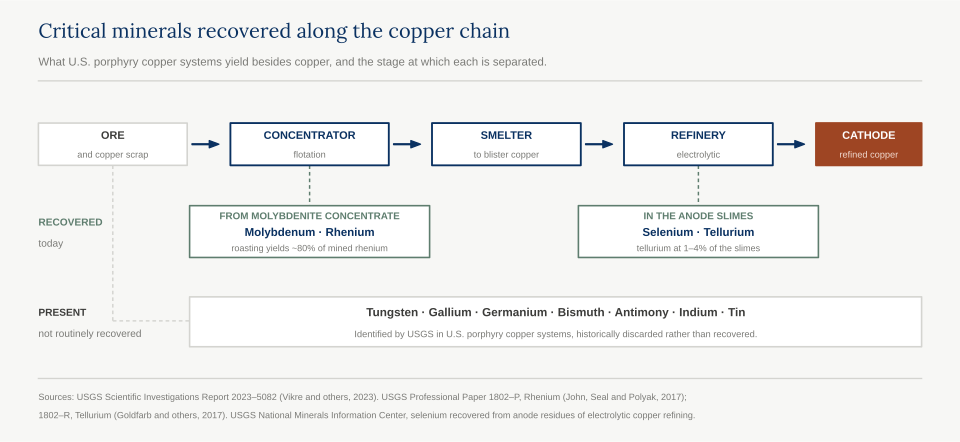
Concentrate shipped abroad carries all of it with the copper. Every stage of domestic copper processing is also domestic critical-minerals processing.
America needs more copper. Every part of the chain has to expand to deliver it.
America needs a stronger copper supply chain. We are expanding it.
America has the ore, the scrap and the demand. What it needs is more capacity at every step, and the largest opening is in the middle of the chain, where ore and scrap become metal. Falcon Copper is an American private company expanding and strengthening the domestic copper supply chain from end to end: across exploration, primary smelting and refining, and allied critical-minerals supply.
- Lawrence Berkeley National Laboratory, 2024 United States Data Center Energy Usage Report, LBNL-2001637, December 2024 (176 TWh in 2023, 4.4% of U.S. electricity; “roughly 325 and 580 TWh in 2028”). escholarship.org
- U.S. Energy Information Administration, Annual Energy Outlook 2026 release materials, 8 April 2026 (data-center load “emerging as the dominant driver of long-term U.S. electricity growth”). eia.gov
- U.S. Department of Energy, National Transmission Needs Study, December 2023 (within-region need up to 128% above the 2020 system by 2035, median of the high load growth case). energy.gov
- Executive Order 14415, Securing America’s Defense Supply Chains and Ensuring Domestic Acquisition of Critical Materials, signed 20 July 2026, 91 FR 46693. federalregister.gov
- International Energy Agency, Minerals used in electric cars compared to conventional cars, 2021 (53.2 kg against 22.3 kg; excludes steel and aluminium; basis is a 75 kWh NMC622 vehicle). iea.org
- Andreessen Horowitz, It’s Time to Mine: Securing Critical Minerals, McEntush and Price-Wright, 29 May 2025. a16z.com
- American Compass, What Is Reindustrialization For?, 24 September 2025 (YouGov, n=1,000, fielded 21–24 March 2025). americancompass.org
- S&P Global Commodity Insights, Copper in the Age of AI: Challenges of Electrification, 8 January 2026 (global demand 42 Mt by 2040, up ~50%; total production peaks ~33 Mt in 2030, primary mined supply peaking near 27 Mt; global defense spending could double to $6 trillion by 2040). spglobal.com
- USGS, Mineral Commodity Summaries 2026 — Copper, February 2026 (copper recovered from scrap about 30% of U.S. copper supply; refinery output 850 kt, of which 60 kt secondary; net import reliance 57%; ore and concentrate exports ~340 kt). pubs.usgs.gov
- Testimony of Adam A. Estelle, President and CEO, Copper Development Association, to the U.S. House Committee on Natural Resources, Subcommittee on Energy and Mineral Resources, hearing Powering the 21st Century with American Copper, 29 April 2026 (16 primary smelters in 1976; the 85 million metric ton urban mine; more than half of U.S.-origin scrap exported). The urban mine and scrap export figures are stated in the testimony without a source citation and are reproduced here as CDA’s own. docs.house.gov
- Federal Register, Final 2025 List of Critical Minerals, 7 November 2025, 90 FR 50494 (copper added). federalregister.gov
- Vikre, P., and others, Critical minerals in subduction-related magmatic-hydrothermal systems of the United States, USGS Scientific Investigations Report 2023–5082, 2023 (rhenium and tellurium routinely recovered; tungsten, gallium, germanium, bismuth, antimony, indium and tin historically discarded). pubs.usgs.gov
- John, D.A., Seal, R.R. II, and Polyak, D.E., Rhenium, chap. P of USGS Professional Paper 1802, 2017 (“about 80 percent of the rhenium obtained through mining is recovered from the flue dust produced during the roasting of molybdenite concentrates from porphyry copper deposits”). pubs.usgs.gov
- Goldfarb, R.J., and others, Tellurium, chap. R of USGS Professional Paper 1802, 2017 (1 to 4 percent tellurium in the anode slimes recovered during copper refining). USGS National Minerals Information Center, Selenium and Tellurium Statistics and Information (selenium recovered as a byproduct of the electrolytic refining of copper, accumulating in anode residues). pubs.usgs.gov
Also in Perspective
How the country built the capacity to make its own copper, and how it lost it, from Indigenous metalworkers and Paul Revere to national electrification.
Read →The United States consumes about 2,200 kt of refined copper a year, mines about 1,000 kt, and refines 850 kt. What closing that gap actually takes.
Read →August 2026. U.S. copper figures on the USGS Mineral Commodity Summaries 2026 basis, published February 2026; 2025 data are USGS estimates. Other figures carry their own sources above. Figures are stated as at the date of publication and are not updated between editions.
This page is a market perspective prepared by Falcon Copper for general information. Third-party data is reproduced as published by the named source. Falcon Copper has not audited or independently validated the underlying data or methodologies, and does not warrant their accuracy. This page is not a technical disclosure of mineral resources, mineral reserves, exploration results, or project economics.
Statements about future markets, demand, supply, and policy are forward-looking and subject to change; actual outcomes may differ materially. Company statements describe publicly announced matters at their stated status only. Nothing here is an offer to sell or a solicitation of an offer to buy any security, and nothing here is investment, financial, legal, or tax advice. See full disclosures.